
Expert guide — White Gold
Heliskiing Nepal: the complete guide before you book
Drop-offs at over 5,500 meters, the highest budget in the industry, altitude restrictions: heli-skiing in Nepal is unlike any other destination. Here's what you need to know before you go.
Heli-skiing in Nepal is not like other heli-skiing destinations: it's the only one where you ski at the foot of 8,000-meter peaks, with drops at very high altitudes and complete exclusivity on the terrain. This unique experience comes at a price, and with its own specific constraints that are best understood before booking.
Why Nepal is unlike any other heliskiing destination
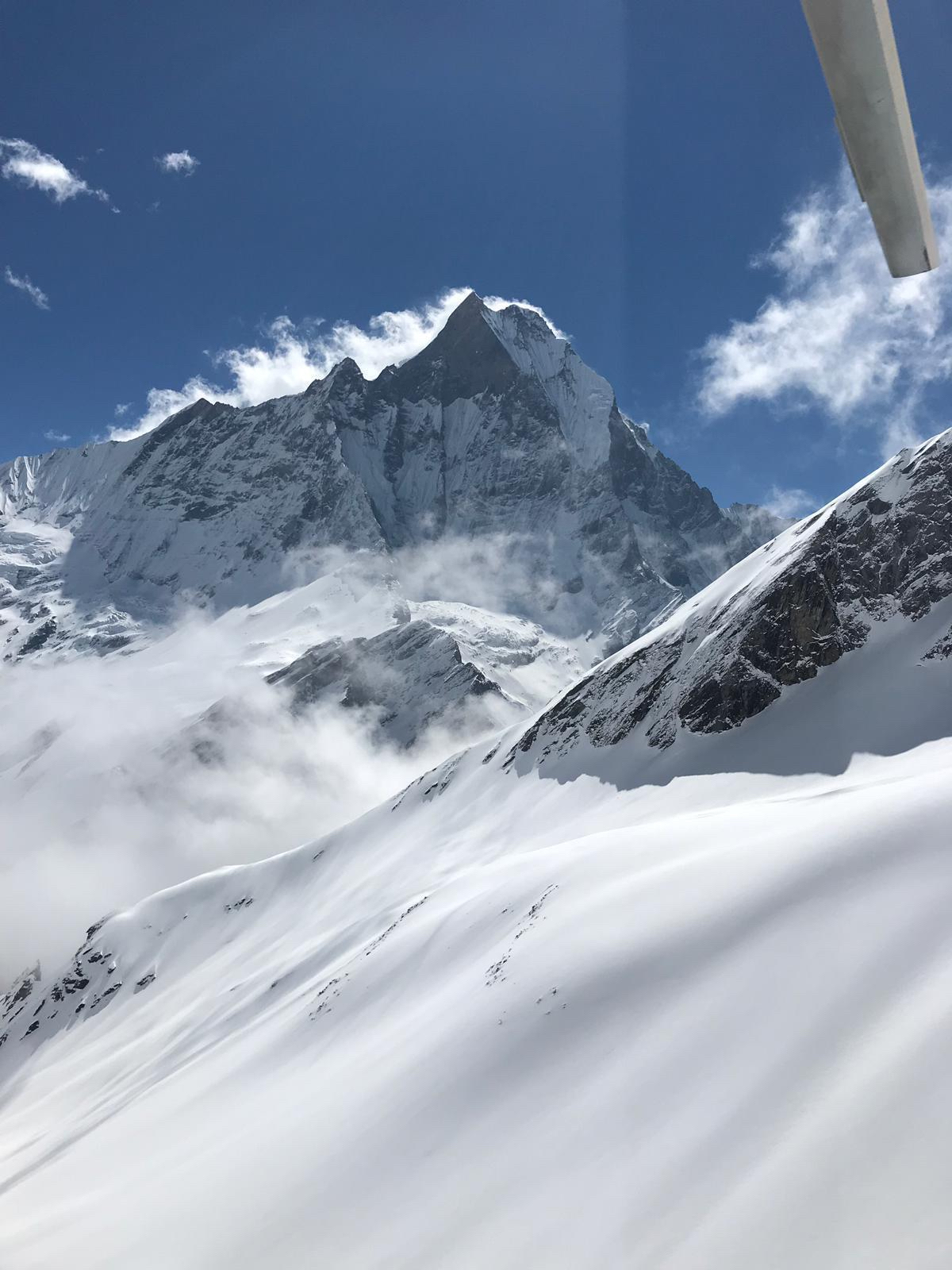
In most heli-skiing destinations worldwide, several operations share the same mountain range. In Nepal, one operation has exclusive access to vast, untouched slopes, with no other heli-skiing activity in sight. Drop-offs take place at the foot of giants like Annapurna and Manaslu, with descents reaching up to 2,000 meters per run.
It is also a cultural experience as much as a sporting one: the stay is structured around Kathmandu and Pokhara, between sacred mountains and Nepalese hospitality.
Why it's one of the most expensive heli-skiing destinations in the world
The price of a heli-skiing trip in Nepal reflects constraints not found elsewhere: official permits for accessing the mountain ranges, deliberately small groups to preserve the exclusivity of the terrain, high-altitude helicopter logistics, and dedicated UIAGM guides. A private package for a group of 6 people with 12 hours of flight time over 6 days costs around €14,300 per person (including VAT). A more comprehensive package, for a small group of 3 people with drops up to 6,000m, reaches €94,500 (including VAT) for the group.
These rates include full board accommodation (Temple Tree Resort in Pokhara, one night at the Mulberry Hotel in Kathmandu), domestic flights, loan of safety and ski equipment, and all permits for access to authorized areas.
What you need to know about altitude before you leave
Unlike high-altitude trekking, where a gradual ascent allows the body time to acclimatize, heli-skiing drops skiers directly at very high altitudes (up to 5,500-6,000 m in the most challenging areas), without a gradual climb. This is an important difference to anticipate.
Good general physical condition and the absence of any medical contraindications are essential. It is recommended to consult a doctor before booking, particularly if you have a history of cardiovascular problems or a known susceptibility to acute mountain sickness.
Why the choice of drivers makes a real difference here
On this route more than anywhere else, the experience of pilots and guides is crucial. Flying and landing at high Himalayan altitudes requires specific expertise, different from mountain piloting at moderate altitudes. An operation built on decades of local experience, with UIAGM-certified guides and a rescue helicopter on permanent standby, significantly reduces the inherent uncertainties of this environment.
This is a criterion to check explicitly before booking in Nepal, even more so than in other heliskiing destinations where safety standards are more homogeneous from one operator to another.
How does the stay actually unfold?
The journey begins with an international flight to Kathmandu, followed by an overnight stay before a domestic flight to Pokhara, where the lodge is located and the heli-skiing program begins. Himalayan weather conditions necessitate skiing early in the morning, before clouds roll in from the valleys in the early afternoon. A typical week includes six days of heli-skiing, with snow cover being renewed almost daily during the season.
What you must remember
- Budget — Expect to pay around €14,300 including VAT per person for a 6-day private package, more for an expedition package
- Altitude — No gradual acclimatization like in trekking; medical advice recommended before booking
- Safety — to verify the actual experience of the pilots and guides on this specific terrain
- Season March and April offer the best weather window and cold snow at altitude.
- Groups — the staff is deliberately limited (3 to 6 people depending on the formula)
View the stay in detail
Full program, lodge and packages available on our dedicated page.
Experience heli-skiing at the top of the world
Let's talk about your project, your level and the formula that suits you to organize your heliskiing trip to Nepal.
What our customers ask before booking
Why is heli-skiing in Nepal more expensive than other destinations?
Access permits to the mountain ranges, deliberately small groups to preserve exclusivity of the terrain, helicopter logistics at high altitude and supervision by UIAGM guides explain a higher budget than in Canada or Europe.
What are the risks associated with altitude when heli-skiing in Nepal?
High-altitude drops are made without gradual acclimatization, unlike a trek. Good physical condition and the absence of medical contraindications are essential; a medical consultation before booking is recommended.
Do you need to be an expert skier for heli-skiing in Nepal?
A good level of off-piste skiing is required. The Himalayan terrain allows for a mix of wide turns on open ground and more technical slopes, adapted to the level and desires of the group.
What is the best time to ski in Nepal?
March and April offer the best window: the snow remains cold and light at altitude, and the days are generally clear in the morning before the arrival of clouds in the early afternoon.
What is included in a heli-skiing trip to Nepal?
Full board accommodation, domestic flights between Kathmandu and Pokhara, loan of safety and ski equipment, as well as all permits for access to authorized areas.