
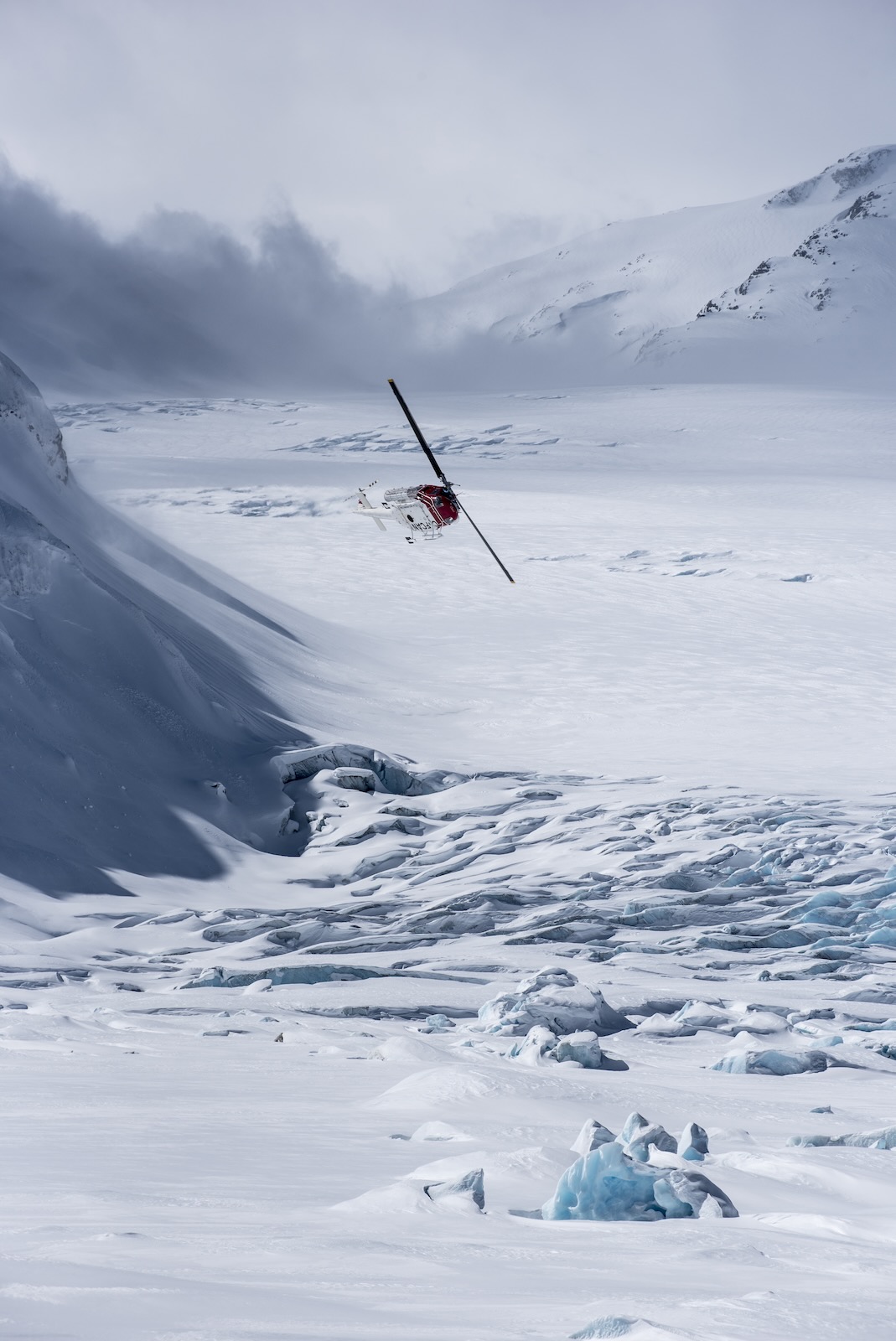
What guides actually do before dropping you off on a virgin slope.
Before booking a heli-skiing trip, one question always comes up in our conversations with clients. Not about the required skill level, not about the price. This one: "Is it really safe?"
That's a good question. And it deserves an honest answer — not reassuring brochure talk, but a concrete explanation of what actually happens on the ground, from the first briefing meeting to the last drop-off of the day.
The short answer: heliskiing in Canada, practiced with certified operators, is an activity governed by some of the most rigorous safety standards in the world of ski mountaineering.
The long answer is this guide.
📋 Summary
- The real risk: let's put the numbers on the table
- ACMG/IFMGA certification: what it really means
- How guides assess avalanche risk
- The safety protocol before each drop-off
- Mandatory safety equipment
- Incident management: what happens if
- The role of each member of the group
- Questions to ask your operator before booking
01 — The real risk: let's put the numbers on the table
Heliskiing takes place in an unmarked alpine environment, at significant altitudes, on slopes that naturally concentrate fresh snow. Risks exist. To deny them would be dishonest.
The main danger is avalanche. Other risks are those inherent to any challenging mountain activity: falls on technical terrain, changing weather conditions, hypothermia in case of prolonged waiting.
What distinguishes supervised heli-skiing from wild off-piste skiing is precisely the entire system put in place to reduce these risks to an acceptable level — and the extreme professionalism of the people who make these decisions every day.
The reputable Canadian operators we work with have solid security histories spanning decades of operation. This result is not a matter of chance; it is the product of a system.
02 — ACMG/IFMGA certification: what it really means
What is ACMG?
The ACMG (Association of Canadian Mountain Guides) is the Canadian certification body for mountain guides. It is affiliated with the IFMGA (International Federation of Mountain Guides Associations) — the international equivalent of the French UIAGM certification.
An ACMG Mountain Guide certified guide (the highest certification) has undergone several years of intensive training covering:
- Mountaineering and high-altitude skiing
- Avalanche risk management at the professional level
- Rescue techniques in complex terrain
- Wilderness First Responder
- Applied mountain meteorology
This expertise cannot be improvised. It is accumulated season after season, mountain range after mountain range.
Why this is important to you
When you go heliskiing with a certified ACMG guide, you are going with someone who has been analyzing the snowpack for years in that specific terrain, knows how the snow behaves at every aspect and altitude, and knows exactly what to do if something goes wrong.
The golden rule: one guide for four skiers
The standard ratio in the lodges we've selected is 1 ACMG guide for a maximum of 4 skiers . This ratio allows the guide to accurately assess each person's skill level, adapt terrain choices in real time, and intervene effectively if necessary.
⚠️ Important note: some less rigorous operators use higher ratios. This is one of the first questions to ask before booking.
03 — How guides assess avalanche risk
Work begins the day before
Every evening, the guides meet to analyze the available data: regional avalanche bulletins (Avalanche Canada), temperature readings, wind data at altitude, history of recent snowfall, and the day's field observations. It's a serious working meeting, not a formality.
Ground assessment every morning
Before the first deposit, the guides carry out tests of the snowpack in control areas: snow pits to analyze the buried fragile layers, stability tests (ECTN, propagation), observation of recent signs of natural avalanche activity.
The decision zone by zone
Each potential ski area is assessed individually according to its exposure (N/S/E/W), its altitude, the slope angle (avalanches mainly trigger between 30° and 45°), its vegetation and its history of behavior.
A slope may be approved for the morning and prohibited in the afternoon if temperatures rise.
💡 The golden rule: if your guide says a slope isn't skiable today, it isn't. Regardless of your skill level, regardless of the snow conditions. This hierarchy of decision-making is non-negotiable—and that's precisely what protects you.
04 — The security protocol before each deposit
Each helicopter drop-off follows a precise protocol, repeated identically for each rotation of the day.
Before boarding
Collective check of avalanche transceivers (transmit mode), probe and shovel in bags, and deployed airbag if applicable. The guide personally checks each piece of equipment, without exception.
In the helicopter
Ski area briefing: identification of safe regrouping areas, areas to avoid, descent plan and emergency plan if an incident occurs during the descent.
At the drop-off
Exit from the helicopter according to a strict protocol (distance, position relative to the rotor blades, wind direction). Immediate assembly outside the flight area before any movement.
During the descent
The group descends in small groups while the others observe from a safe position. The entire group never descends together on an exposed slope.
This rule of "one by one under supervision" is fundamental — and it admits no exceptions.
05 — Mandatory safety equipment
What the lodge provides
In all the lodges in our selection, avalanche safety equipment is provided and checked daily:
DVA (Avalanche Victim Detector)
The device must be switched on in transmit mode at all times. It is the tool for locating a buried victim. Proficiency in search mode is verified during the first-day briefing.
Probe
Used to precisely locate the victim once the avalanche transceiver signal is received. Essential to avoid digging in the wrong place and wasting critical time.
Leather
The often underestimated link in the trio. In an avalanche, the time it takes to get out is vital. A lightweight but sturdy shovel makes all the difference.
avalanche airbag
Included in most of the high-end lodges in our selection. In the event of deployment, the inflated airbag statistically increases the skier's position towards the surface of the deposit, reducing the risk of deep burial.
What you need to know how to use
Having the equipment is not enough. All guides organize an avalanche transceiver exercise on the first morning : simulated search with a transmitter buried in the snow, training in probe use and rapid shoveling techniques.
💡 If you've never practiced this exercise, do it before you leave. Many ski resorts in France organize avalanche awareness days open to everyone.
06 — Incident management: what happens if
In case of avalanche
The protocol is clear and regularly practiced by all guides:
- Observation and security — Identify the deposit area and ensure the slope is stable before intervening
- Activating avalanche transceivers in search mode — all unburied members of the group simultaneously
- Probe location — fine-tuning the DVA signal for precise positioning
- V-shaped exhumation — rapid shoveling technique, immediate preservation of the airways
- First aid and evacuation — the helicopter, in constant radio contact with the guide, is urgently redirected
⚠️ Time is of the essence: a buried victim's chances of survival drop sharply after 15 minutes. Therefore, the responsiveness and proficiency of all group members, not just the guide, are essential.
In case of a medical accident
Each guide is trained in wilderness first aid (Wilderness First Responder or equivalent). The lodges have a fully stocked mountain pharmacy and a medical evacuation plan that can be activated within minutes. The helicopter, already on site for drop-offs, can be redirected for emergency evacuations if needed.
07 — The role of each member of the group
Safety in heliskiing is not solely the responsibility of the guide. It is a collective responsibility.
Your specific role on the ground:
- Communicate honestly your actual level during the initial briefing — not your best day, your average day
- Listen to and follow the guide's instructions without negotiation
- Stay together and wait for the signal before starting.
- Master the use of your avalanche transceiver before setting off
- Report any fatigue or discomfort immediately — a decision made due to exhaustion is a risky decision.
- Never ski alone or outside the area approved by the guide
This is not administrative constraint. It is the foundation of a system that works.
08 — Questions to ask your operator before booking
Before confirming a heli-skiing trip in Canada, here are some questions to help you seriously assess an operator's reliability. A reputable operator will answer all of these questions without hesitation. Vague or evasive answers are a red flag.
On the guides
- What certification do the guides have (ACMG Mountain Guide — highest level)?
- What is the guide/skier ratio used?
- How many seasons of experience in this specific territory?
Regarding the protocols
- What is the daily avalanche risk assessment protocol?
- Is the safety equipment (avalanche transceiver, probe, shovel, airbag) provided and checked daily?
- Is an avalanche transceiver (DVA) exercise organized at the beginning of the stay?
On the urgency
- What is the medical evacuation plan from the most remote areas?
- Is there permanent radio contact between the pilot and the guides on the ground?
Choosing an operator means choosing your level of security.
The difference between a safe heliskiing trip and one that is less safe is not about the terrain — it's about the people who make the decisions each morning.
The guides we select at L'Or Blanc Travel have been working in these mountain ranges for years. Our selection includes only certified operators, with confirmed ACMG guides and proven safety protocols. This isn't just a formality—it's the number one criterion in our selection process.
→ Ask for advice on destinations and operators
Article written by the L'Or Blanc Travel team · Canada heliskiing specialists for over 10 years · +33 6 16 70 90 65 · info@lorblanc-heliski.com