
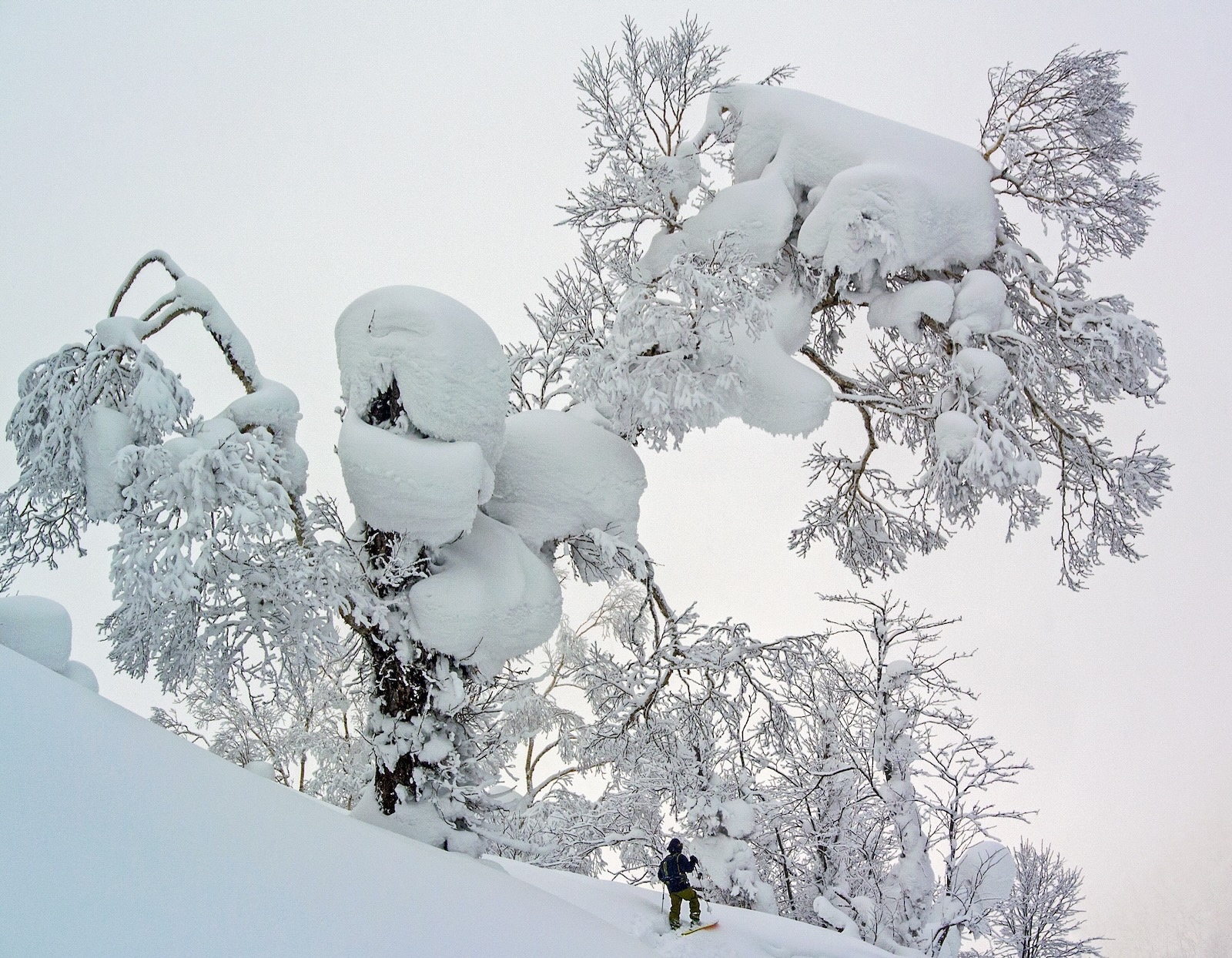
1. Why Hokkaido for freeriding
Hokkaido receives exceptional amounts of snow every winter thanks to cold flows from Siberia that pick up moisture over the Sea of Japan.
Result: a very dry and light powder, which became famous under the name of Japow.
The forests are spaced far enough apart to allow for smooth tree-skiing, and the volcanic slopes offer gradual relief, ideal for linking runs.
Add to that a welcoming culture, natural hot springs, remarkable cuisine and perfectly oiled logistics: Hokkaido is the ideal compromise between pure adventure and premium comfort.
2. The must-see spots (and their specificities)
Niseko: the “gateway” to Japow
Niseko is known for its network of gates (gates) that govern access to the backcountry.
You enter and exit the off-piste areas via these gates when they are announced to be open.
It is an ideal place to experience Japow safely, respecting local rules and being duly equipped (DVA, shovel, probe, helmet).
Good to know: Never go under a rope. Controls are strict, and off-piste rescues may be charged.
Furano: steep slopes, more local atmosphere
More central, Furano benefits from a slightly more continental climate: the powder is often very "held".
The terrain is more open and varied, perfect for days where you mix things up. freeride by lifts et small skin approaches to switch to discreet valleys.
Asahidake: the “wild” volcano
A cable car drops you high on Hokkaido's highest active volcano.
Above, there are no groomed slopes: natural corridors, valleys, fumaroles, accumulations... and sometimes changeable weather.
A spot of character for experienced skiers, supervised by guides experienced in reading the terrain.
Tokachidake: 100% freehiking
No chairlift: it's the pure hiking. When the stars align, you often live your best powder day of the season.
Silence, immensity, perfect valleys: the very essence of freeriding.
Depending on the weather and wind direction, we include Rusutsu and Kiroro in the itinerary to maximize snow quality.
The goal: more “blower pow” runs, less waiting.
3. What others often forget to say
- The gates of Niseko are not a detail. This is the local backcountry golden rule. Follow the opening/closing of the day; never cut under the ropes.
- Asahidake is not a classic resort. A cable car, then open terrain: visibility, wind, orientation, choice of lines... this requires real expertise.
- The “quality” of powder varies across the island. Proximity to the sea = frequent falls; inland = powder that is often drier and more consistent. Spots are adjusted accordingly.
4. Ski Safari Hokkaido by L’Or Blanc Travel
Our Hokkaido Ski Safari is designed to stick to the best snow of the day: we move intelligently between Niseko, Rusutsu, Kiroro, Furano, Asahidake and Tokachidake.
6 days of skiing, an guide for 4 skiers, private transfers, ski passes included, accommodation chosen for comfort and proximity to departures.
Typical itinerary (8 days / 6 skis)
D1: arrival in Sapporo → private transfer → installation in Niseko.
D2-D4: Niseko / Rusutsu / Kiroro depending on conditions (gates & forests).
Day 4 evening: transfer to Furano.
D5-D7: Furano / Asahidake / Tokachidake (freeride + hiking) depending on the weather.
D8: return transfer Sapporo → international flight.
Accommodation & logistics
In Niseko: hotel with onsen, according to the confirmed program.
In Furano: elegant hotel with baths and sauna for effective recovery.
All inter-spot transfers are private and orchestrated by our teams.
Included: 7 nights, 6 days of skiing, 1 guide for 4, private transfers, ski passes, local taxes.
Not included: international flights, freerando equipment (skis/split), PPE (DVA-shovel-probe), lunch/dinner depending on the package.
➤ Discover our dates, private options and tailor-made services:
Ski Japan – Hokkaido by L’Or Blanc Travel.
Japanese snow, Japow: what are people looking for in Hokkaido?
"Japanese snow" often refers, among skiers, to the powder snow associated with Hokkaido. Japow combines the words Japan and powder. This name evokes a skiing experience; it does not guarantee snowfall every night or identical conditions across the entire island.
When planning a trip, the key question is: what itinerary allows you to choose terrain suited to the day's conditions? A multi-day ski tour leaves room for adjustments between resorts and mountain areas. Wind, visibility, lift openings, and snowpack conditions can all alter your objectives. A forest doesn't eliminate the risk of avalanches, and open access doesn't mean every slope is suitable for every group.
What skill level is required for a freeride trip in Hokkaido?
Describe your actual experience: types of snow you've skied on before, comfort level in the trees, speed control off-piste, and familiarity with skinning uphill. Good on-piste technique alone doesn't guarantee independence in deep snow. Group size, pace, and objectives should be discussed before booking.
How to prepare your residency application
- Please specify your dates and the number of participants.
- Indicate whether you mainly want to use the lifts or incorporate freerando.
- Describe your off-piste skill level and physical condition.
- Ask for the total duration of the trip, the services included, the insurances and the modification conditions.
Discover our ski safari holiday in Japan or compare our freeride and freerando holidays.
Seasonal information: Japan National Tourism Organization — skiing in Japan . Local conditions and itinerary to be confirmed before departure.
5. When is the best time to go skiing in Japan?
According to the Japan National Tourism Organization, January and February generally see the most consistent snowfall. March can also be snowy, with greater temperature variation. The White Gold program is offered in January and February; dates and availability must be confirmed with the team. No specific period guarantees precise snow conditions.
What budget should I plan for a ski trip to Japan?
The price of a ski trip to Japan depends on what you're comparing: accommodation only, a week at a resort, or a guided freeride tour. To calculate your budget, separate the cost of the land pass, airfare, and personal expenses.
L'Or Blanc offers a ski safari in Hokkaido starting from €4,100 per person (all taxes included) for seven nights and six days of skiing, in a private group of four with a guide. Price checked on November 9, 2026, subject to confirmation based on dates and program chosen.
What's included in the price of the ski safari
The package includes double rooms in hotels with breakfast, van transfers within Hokkaido, tours, guiding, and local taxes. Flights, lunches, dinners, drinks, personal equipment, and safety gear are not included. Safety equipment rental is available upon request.
Expenses to calculate before booking
- Flights: Compare the entire journey to New Chitose, connections and ski or snowboard luggage.
- Meals: Plan an allowance for lunches, dinners and drinks for the entire duration of the trip.
- Equipment: Get a quote for the necessary rentals, their duration and any potential transport costs.
- Additional nights: Check if flight schedules require an extra night before or after the stay.
- Insurance: Check the coverage in your contract for planned activities, assistance, and cancellation.
Compare two quotes with equivalent services
Check the actual number of guided days, group size, overnight stays, transfers, and included packages. A lower price may cover fewer services. For a complete quote, please provide your dates, departure airport, number of participants, and rental requirements.
Request a personalized budget for Japan
Up-to-date availability and services can be found on the Hokkaido ski safari page.
6. Equipment & safety: the freerando checklist
- Freeride skis 100–105 mm (or splitboard) + approach skins.
- Avalanche PPE Avalanche transceiver, shovel, probe (mandatory). Airbag pack is mandatory in the proposed program.
- Helmet & back protector : strongly recommended in the forest.
- Clothing : breathable layering, warm gloves, versatile mask (changing lights).
- Condition : days filled with “tree runs” and volcanic valleys; a good physical background maximizes the pleasure.
7. Culture & onsens: the art of recovery
Le onsen ritual is an integral part of a ski holiday in Japan: we wash before entering, we avoid wearing swimsuits (except in private baths), we respect the peace and quiet of the place.
In case of tattoos, favor a kashikiri (private bath) or a tolerant establishment.
After a long day in powder, it's the best way to relax after skiing.
8. FAQ – Everything you need to know before booking
What is the difference between Niseko, Furano, Asahidake and Tokachidake?
Niseko: backcountry marked by gates and generous forests.
Furano: often very dry powder, steeper slopes, local atmosphere.
Asahidake: cable car + natural volcanic terrain, weather to be monitored.
Tokachidake: 100% hiking, solitude and legendary runs on good days.
Can we combine ski lifts and hiking?
Yes. That's the strength of the Safari: we combine gated off-piste, lifts, and skin segments to find the best snow of the day.
Do you offer heliskiing in Japan?
In Japan, our offering is a ski safari in Hokkaido, dedicated to guided freeriding and ski touring, not a heli-skiing trip. Tell us about your skill level and expectations so we can plan your trip.
How are transfers organized?
Welcome to Sapporo (New Chitose), private transfers to Niseko and Furano, and return to Sapporo for your flight. You don't have to worry about anything: we take care of everything.
Need personalized advice? Contact our experts: we'll tailor your itinerary to your level, dates, and preferences.